Texte
Welcome to EBVS, European Board of Veterinary Specialisation

 Committed to ensure the highest quality of veterinary medicine in Europe by specialisation
for better quality of life of animals and people.

Text
Video file

Veterinary Specialist Colleges

Block

Colleges

European College of Veterinary Pharmacology and Toxicology

European College of Veterinary Pharmacology and Toxicology (ECVPT) Objectives: To advance veterinary and related biological sciences, as well as animal health care in Europe, by promoting research and heightening the skills of veterinarians in veterinary pharmacology and toxicology. To establish guidelines for post-graduate education, serving as prerequisites for becoming a  EBVS® European Veterinary Specialist in veterinary pharmacology and toxicology. To conduct examinations and qualify veterinarians as  EBVS® European Veterinary Specialists in Veterinary Pharmacology and Toxicology, ensuring the provision of expert care to the veterinary patient, its owner, and the general public. To foster communication and share knowledge regarding veterinary pharmacology and toxicology among veterinary peers and the wider community.

European College of Veterinary Surgeons

European College of Veterinary Surgeons (ECVS) Objectives: To foster research and elevate the competency of veterinarians in veterinary surgery for both small and large animals across Europe. To establish guidelines for post-graduate education, paving the way to become a  EBVS® European Veterinary Specialist in Veterinary Surgery. To conduct examinations and certify veterinarians as  EBVS® European Veterinary Specialists in Veterinary Surgery. To promote communication and the dissemination of knowledge regarding veterinary surgery among veterinary professionals and the wider public.

European College of Veterinary Sports Medicine and Rehabilitation

European College of Veterinary Sports Medicine and Rehabilitation (ECVSMR) Objectives: To promote research and heighten the competency of veterinarians in the multidisciplinary specialty of veterinary sports medicine and rehabilitation in Europe. This encompasses the comprehensive examination, diagnosis, treatment, and prevention of sport and work-related injuries/disorders, utilizing a holistic approach central to which are controlled exercise, functional training, and various therapeutic modalities. To establish guidelines for post-graduate education, serving as prerequisites for becoming a  EBVS® European Veterinary Specialist in Veterinary Sports Medicine and Rehabilitation. To conduct examinations and certify veterinarians as  EBVS® European Veterinary Specialists in Veterinary Sports Medicine and Rehabilitation. To bolster communication and knowledge dissemination about veterinary sports medicine and rehabilitation among veterinary professionals and the broader public.

European College of Equine Internal Medicine

The primary objectives of the European College of Equine Internal Medicine (ECEIM) are to advance the level of expertise in care for horses, ponies, donkeys, mules and other equidae with medical diseases. The college’s purpose serves to advance equine internal medicine. The college oversees: Developing methods of graduate teaching in equine internal medicine, especially through residency programmes Training,  examining and certifying candidates for EBVS® European Veterinary Specialist in Equine Internal Medicine Providing guidelines for post-graduate education Promoting advances in equine internal medicine, and  Developing and organising continuing educational courses in equine internal medicine Encouraging research and other contributions to knowledge relating to pathogenesis, diagnosis, therapy, prevention, and its control of diseases directly or indirectly affecting equidae, Promoting communication and dissemination of this knowledge.

European College of Laboratory Animal Medicine

European College of Laboratory Animal Medicine (ECLAM) The main goal of ECLAM is to enhance expertise in laboratory animal medicine. This is achieved by: Establishing graduate teaching methods, particularly through residency programs in laboratory animal medicine Training and certifying veterinarians as EBVS® European Veterinary Specialists in Laboratory Animal Medicine Setting guidelines for post-graduate education Championing improvements in laboratory animal welfare and medicine Organizing ongoing educational courses in laboratory animal medicine. Conducting scientific research

European College of Porcine Health Management

The primary objectives of the European College of Porcine Health Management (ECPHM) are to advance porcine health management in Europe by enhancing the health and welfare of pigs, ensuring the production of safe and high-quality pork products for consumers, and bolstering the economic profitability of the sector through expert care, all while respecting the environment for sustainable agriculture. The ECPHM has set benchmarks for  EBVS® European Veterinary Specialists in Porcine Health. The college is responsible for: Formulating methods for postgraduate teaching in porcine health management, primarily via residency programs. Training and qualifying professionals as specialists in porcine health management. Certifying veterinarians as specialists in the field. Setting standards for post-graduate education in porcine health. Championing advancements in porcine health management. Designing and offering continuous educational courses in the specialty. Encouraging research in porcine health and facilitating knowledge sharing.

European Veterinary Dental College

European Veterinary Dental College (EVDC) Objectives: To foster research and elevate the proficiency of veterinarians in the art and science of veterinary dentistry. To establish guidelines for post-graduate education, guiding the pathway to becoming a  EBVS® European Veterinary Specialist in Veterinary Dentistry. To administer examinations and certify veterinarians as EBVS® European Veterinary Specialists in Veterinary Dentistry. To advocate for communication, collaboration with national and international veterinary dental associations, and the dissemination of knowledge in veterinary dentistry.

European College of Veterinary Dermatology

The primary objectives of the European College of Veterinary Dermatology (ECVD) are: To elevate the standard of veterinary dermatology, emphasizing research and the continuous advancement of the field, ensuring the highest level of care for animals with skin conditions. To provide and uphold stringent guidelines for postgraduate education, directing veterinarians towards the revered title of European Veterinary Specialists® in Veterinary Dermatology. To oversee rigorous examinations and certify veterinarians as European Veterinary Specialists® in Veterinary Dermatology, validating their proficiency and commitment to the discipline. To foster open communication, knowledge-sharing, and collaborative learning in veterinary dermatology amongst veterinary professionals and the broader public, highlighting the pivotal role of research and knowledge dissemination in this specialty.

European College of Veterinary Microbiology

The primary objectives of the European College of Veterinary Microbiology (ECVM) are: To champion the advancement of veterinary microbiology across all European nations. This involves fostering in-depth research, pushing boundaries of knowledge, and ensuring the continual improvement of veterinary medical services for the benefit of the public. To formulate and implement precise guidelines for post-graduate education, providing a structured pathway for veterinarians aspiring to specialize in veterinary microbiology. To conduct rigorous examinations and subsequently certify veterinarians as  EBVS® European Veterinary Specialists in veterinary microbiology. This recognition not only assures the competency of the professionals but also ensures the provision of expert care to animals affected by microbiological diseases. To facilitate an environment where continuous learning is encouraged. This includes promoting advances in veterinary microbiology, organizing continuing educational courses, and emphasizing the significance of research. Equally crucial is the dissemination of this expansive knowledge among veterinary peers and the wider community.

European College of Small Ruminant Health Management

The primary objectives of the European College of Small Ruminant Health Management (ECSRHM) are: To advance veterinary expertise in small ruminant health management, encompassing sheep and goats, by championing research and elevating the capabilities of veterinarians in this speciality. To formulate guidelines and benchmarks for postgraduate education, ensuring veterinarians are on a clear trajectory to attain the title of European Veterinary Specialist® in Small Ruminant Health Management. To organize examinations and certify veterinarians as European Veterinary Specialists® in Small Ruminant Health Management, while fostering a consistent, evidence-based medicine (EBM) approach. To facilitate communication, continuous education, and the distribution of knowledge in small ruminant health management amongst both professionals and the wider audience, underpinning the significance of original scientific research and contributions to pertinent literature.
Text

Countries

Image
EBVS organisation map

EBVS® is a European organisation focussed on veterinary specialisation in the Member States of the European Union and its neighbours, particularly Switzerland and Norway. EBVS specialists are also found in other countries.

Text

 EBVS Congress 2026
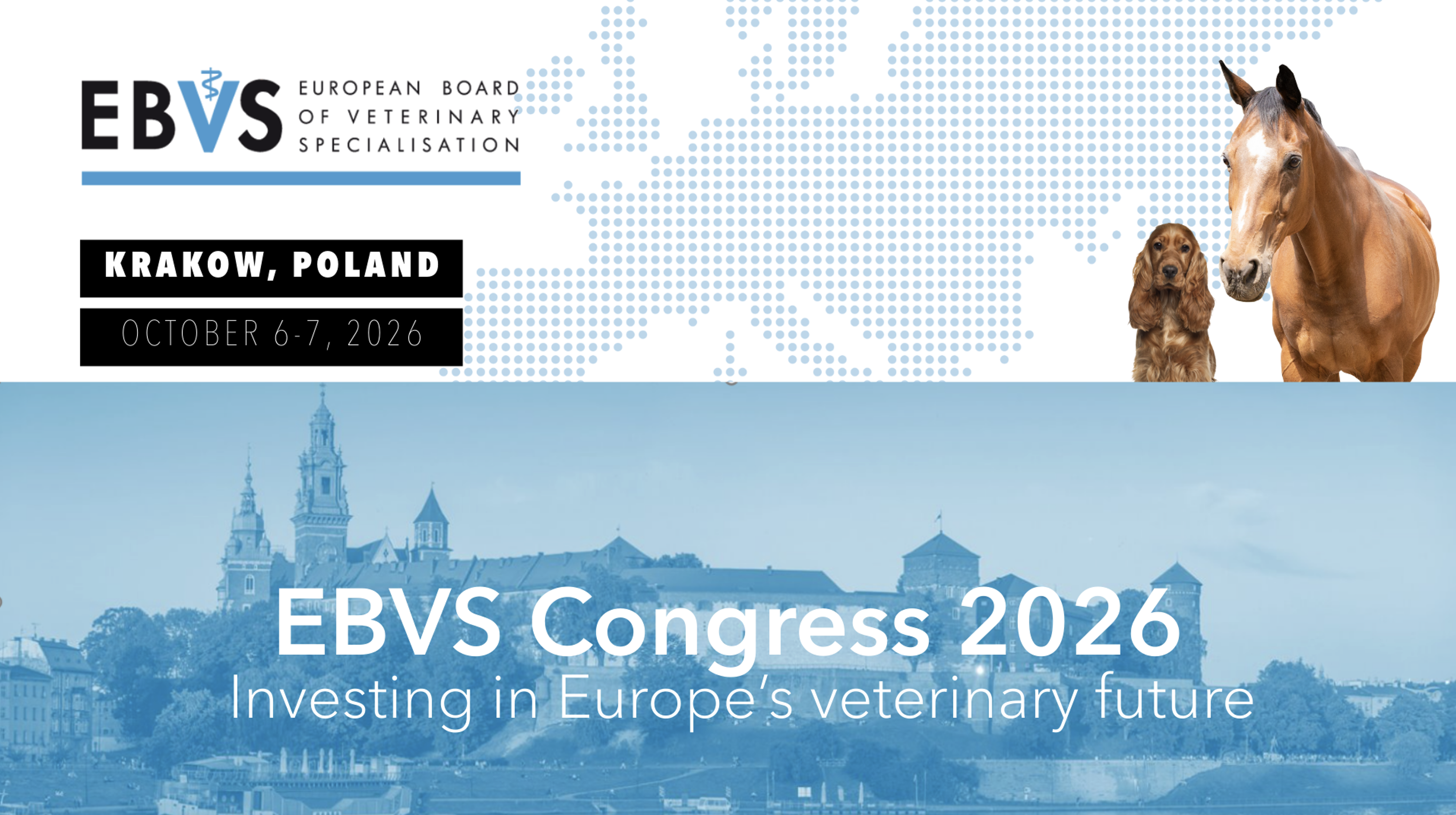
EBVS Congress 2026

Block

Vacancies

Texte

Helpdesk

Texte

 EBVS Congress 2026